News
Housing sparks rage on TikTok. Climate solutions can help ease it.
A tax advisory firm posted a video built around a simple story: Juan in 1985, at the age of 28, had his own flat, his own car and was saving money; Juan in 2025, at the same age, pays €600 for a room and barely makes it to the end of the month. The video got 316,800 views, which is not a particularly high figure for our corpus. What is striking is its 4,738 comments. The median number of comments in our database is 517. This video gets around nine times that.
In the comments, we see a strong generational confrontation around who had it harder, who worked harder, and what it means today to be able to build an adult life.
Frustrations and aspirations are always present in housing content, and this is an example of how a piece of content channels latent discontent. The comparison between two life stories turns into generational confrontation. What drives this kind of content to go viral is the gap between what is shown and the viewer’s own experience. If we want to communicate about housing from a climate perspective, we will need to help audiences navigate these intense emotions.
How we got here
We have been analysing a dataset of 8,756 housing-related TikToks using different methods. We now focus on exploring this large database to identify where it intersects with climate issues and answer a practical question: what content strategies could we develop? The idea is to offer some pointers for communicators and creators producing content from a climate perspective.
From the full dataset, we selected the most recent and most viewed content: the top 25% by likes (more than 9,828 likes) among videos published between January 2025 and February 2026. This left us with 1,248 videos.
We downloaded all the videos and transcribed the audio using a language model specialised in this task. We then ran the transcripts and the text of each post through a classifier using another language model, looking for mentions of climate solutions related to housing and its immediate surroundings.
We drew our list of solutions from Fundación Renovables’ Ecological Strategy for Small Municipalities. From this, we defined three main families of solutions that can be associated with housing: renewable energy, energy efficiency, and solutions in the surrounding environment.
The classifier makes the task easier, but it also makes quite a few mistakes. That is why we reviewed the content manually. Among the videos where the classifier detected a mention, we identified 92 that touch on a climate solution, either directly or in passing. This already tells us something: within the viral conversation around housing, the climate signal is very marginal.
The most common “solution”: the natural environment turned into a housing asset
Of the 92 videos that touch on some kind of solution, the most common one is not a solar panel or an air-source heat pump. It is having nature nearby. The surrounding environment appears in 69 videos and, within that, natural areas appear in 52. And they appear in a very specific way: as an asset of the home (views of the mountains or the sea, being surrounded by nature, the country house), something that adds value to the property.
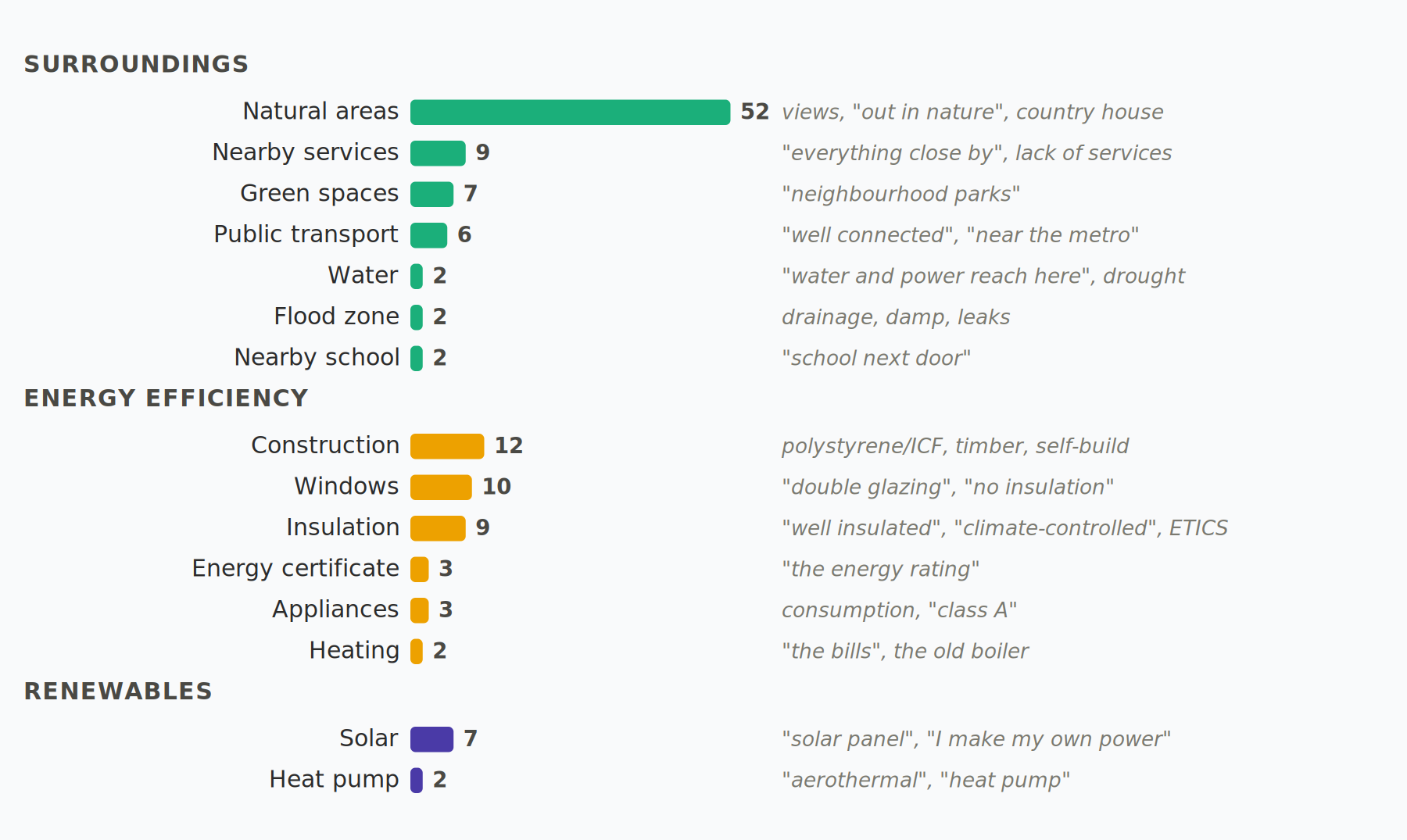
How are these solutions talked about? First of all, they are not presented as “solutions”, even though they are present when a home is shown. The natural environment becomes a selling point. Energy efficiency appears mainly in prefabricated homes, where insulation to keep out the cold is key, as are good windows. In technical construction content, or in content by architects who explain their work, solutions are discussed more directly. Renewables appear less often, with solar panels standing out as a symbol of independence in alternative lifestyles (permaculture and living in the countryside).
There are also solutions we actively looked for but did not find. Energy communities do not appear; there is content about renovations, but not about housing retrofits; and air-source heat pumps barely feature, much like energy performance certificates. There are no mentions of low-emission zones, support for sustainable mobility (bikes, chargers, electric cars linked to the home), or solar shading such as awnings.
We can conclude that there is still limited awareness that climate solutions linked to housing are basic criteria for habitability, and that these standards are not always met. At the same time, the homes shown on TikTok are far removed from the housing reality many people experience. They are influencers’ homes, properties ready for sale, new or renovated, certainly beyond the financial reach of most people but generally offering good conditions and “comfort”. To some extent, these quality standards are simply taken for granted. The problem itself is not brought into focus, partly because framing housing as a market asset leads you to think mainly in terms of choosing well.
Where solutions appear: the content formats that already work
If we manually classify the content that includes solutions, a typology emerges based on the patterns we observed.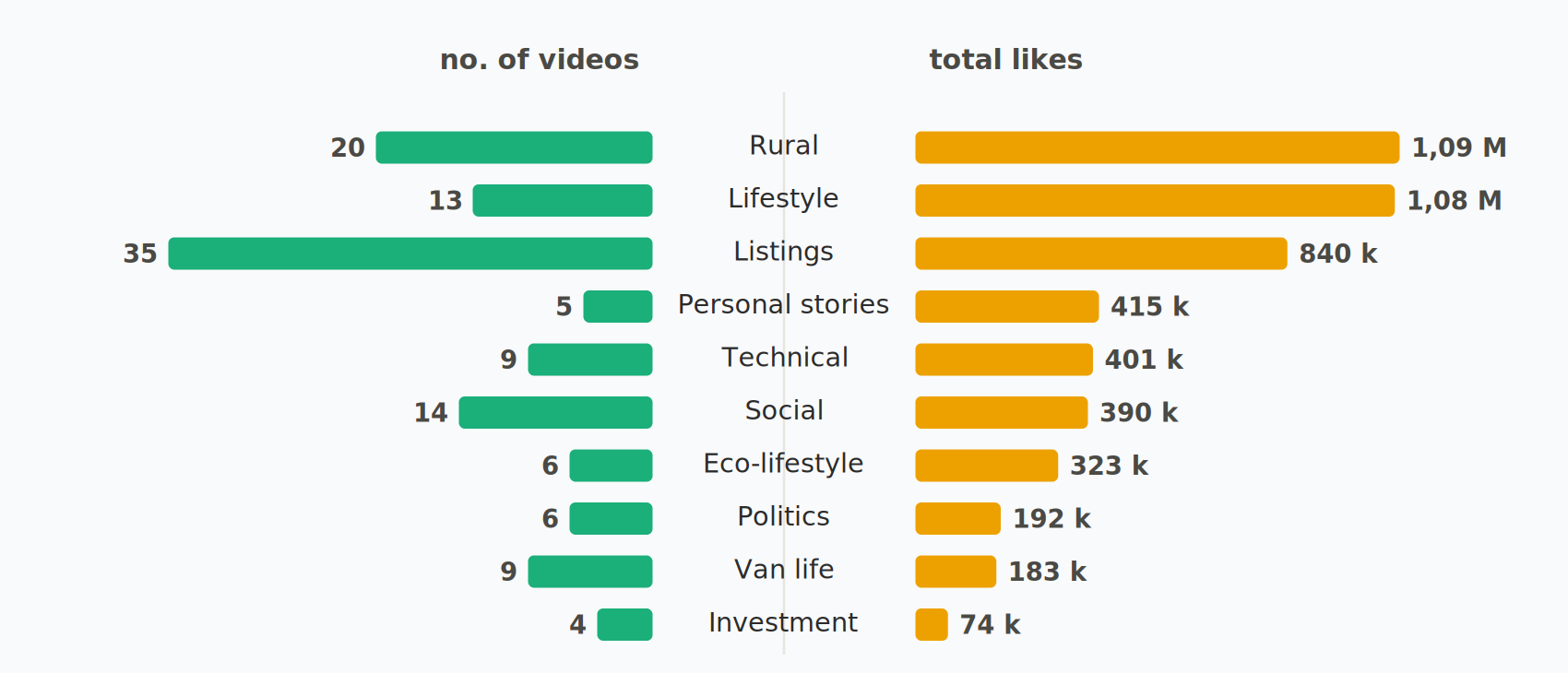
Property listings and lifestyle content dominate here too, just as they do across the wider housing conversation. Lifestyle influencers — mostly women — clearly have a strong impact and could help communicate more sustainable habits. In general, they tend to promote more consumerist lifestyles that are beyond the reach of many people, but for our strategies we could identify creators who reach our audiences and have more down-to-earth, sustainable lifestyles. One pleasant discovery is Betsa Bermúdez, who has a young, female audience. In this video, she explains why she is leaving Barcelona — an old flat, an exorbitant rent and a winter spent feeling cold because of the old windows — and moving to Galicia. It is a good example of how climate solutions can be mentioned implicitly in lifestyle content while helping audiences develop better criteria.
Estate agents (women) are undoubtedly a very relevant messenger. Once again, we could consider a strategy based on mapping estate agencies with a more approachable profile or those specialising in rural areas. They already produce impactful content on a regular basis, and if they had more information about the climate solutions present in the homes they show, they would probably communicate them more often and more effectively. In this area, we looked closely at the content produced by Susana Adkinson from Grupo Country Homes.
We are missing house tours produced by sustainable architecture studios. This may be one of the content formats with the greatest potential for us. These studios already have a strong climate awareness, and walking through the homes they renovate or build creates many opportunities to talk about solutions. It is worth asking why they are not already incorporating this into their digital strategies, because we believe it could work very well.
If there is budget available, or if you want to give the content more impact, you can always invite a content creator or influencer to make it more engaging. Ideally, the format would involve walking through the house, showing its features or talking to the people who live there so they can share a story that matters to us. These kinds of videos can also be made from outside using a “walk and talk” format. Jacobo De Santiago, for example, is a great source of inspiration for showing how vegetation can contribute to wellbeing at home.
Where to live better is an active conversation, and we can compare cities using climate criteria:
As we have already seen, Betsa Bermúdez is doing this by moving from Barcelona to Galicia. In other content, we see a pattern of comparing cities explicitly and in a friendly way, creating a natural opening to introduce climate criteria. In another video, creators rank the best cities in Spain based on factors such as access to natural spaces, overtourism, prices and climate, including a direct mention of summer heat.
We couldn’t resist including a second example that we think could inspire and serve as a reference for creating content. Here, Anita, a migration adviser, presents Zaragoza as an ideal city in which to start a new life. In doing so, she ends up mentioning several criteria that intersect with climate issues in an implicit way: affordable rents, transport connections, a good climate, and the sense of calm associated with green spaces.
At this point, some climate communicators may be wondering whether it is really their role to assess cities and try to influence people’s decisions. Clearly, that is not the goal, but there are reasons to enter this conversation. First, we should remember that many other messengers with less ethical interests are already trying to influence people’s life and financial decisions with very little care. We, on the other hand, can bring useful criteria and open up the conversation from a different place. Sharing what we know has value and can help people. The recommended city can become secondary; what matters is highlighting the measures that help cities adapt to climate change.
A quieter life in the countryside is compared with life in the big city:
Content around rural life becomes more relevant when we look for solutions (see general analysis). People move away from the city in search of the affordability the countryside can offer, while valuing peace and quiet and proximity to nature. These videos convey the excitement of starting a new life project: they show you how to live in the countryside, how to find a home, the advantages of a quieter life, the possibility of having several dogs and sharing walks.
Ainhoa, for example, shows us rural life and compares the prices where she lives now with the “unthinkable prices” of where she used to live.
The solar panel represents the independence of living in the middle of the countryside:
In the content we have called Eco-Lifestyle, there is a further step towards living outside the system. These are posts from communities centred on permaculture or alternative ways of life. In this context, the solar panel appears as a symbol of independence. The ability to grow your own food and avoid depending on the supermarket is also part of the picture. We were especially struck by the tender story of this young man living in the countryside and supplying his own energy with a solar panel. It is a surprising and inspiring story.
It is striking that we did not find more mentions of solar panels in viral content, whether in villages or cities. Here, they clearly take on a strong meaning of resilience in the face of adversity, which says a lot.
Exceptional people show that it is possible to live differently
We found other similar Eco-Lifestyle content that relies on exemplary stories: people who embody an alternative way of life and serve as proof that “it is possible to live differently”. These are inspiring stories built around an almost heroic figure, as in the case of Yaya Bushcraft, a 70-year-old woman who has built four cabins with her own hands using only natural materials and lives without running water or electricity. These stories inspire and expand what feels imaginable, although they present ways of life that are difficult to translate into the audience’s everyday reality.
The appeal of cheap housing: prefabricated homes
These can be converted containers, modular homes or mobile homes. They are presented as an affordable housing option, with good insulation and double glazing used as selling points. They represent another possibility for people on more modest incomes. The messengers here are often people with Latin American accents, as well as Roma and non-Roma people. This content gives you everything you need to know about this type of housing.
Technical and educational content is where solutions are explained most clearly:
Here we found only a small number of posts, but they fall into three types:
1) Eco-inventions that surprise: Although they are exceptional and not always a realistic solution in our context, they can still be useful for educational purposes. In this example, polystyrene foam is used in construction to improve insulation. Most of us do not really know how a house is built, and showing the process generates curiosity. The exceptional always attracts attention on social media. It is also worth noting that “eco-inventions” are a format that works in itself (as the website ecoinventos.com demonstrates), even if they can sometimes be anecdotal or superficial. The question here is: which eco-inventions, which stories, can we build into our communication strategy?
2) Visual engineering that holds attention: 3D visualisations and AI-generated animations are used in engineering content to explain flood-prevention measures. These formats capture attention through constant visual stimuli and help make complex technical solutions easier to understand. They can be useful for explaining climate measures such as the infrastructure needed in flood-prone areas. In previous analyses, we had already observed how accounts linked to engineering communities use this kind of resource. They also have the potential to connect with an audience that is often less engaged with climate content: adult men.
3) Architects are the perfect explainers of climate solutions: Jordi Martí is a technical architect specialising in the energy efficiency of buildings, and he has found effective formats for communicating these solutions. He entered our sample thanks to a viral video with more than 1.9 million views about window insulation. On his profile, he also explains many other insulation and energy-efficiency solutions related to housing.
Content ideas to take away
So far, we have explored several pieces of content that stand out in the analysis, highlighting some strategic insights along the way. In this section, we are taking the plunge and recommending content ideas more directly to reinforce some of those points. Not all of them will necessarily resonate with you, but we hope some of these ideas will be useful to someone:
Introduce climate solutions and climate criteria into lifestyle content. In house tours and aspirational content, mention insulation, windows, orientation or solar panels as part of what makes a home attractive.
Talk about the comfort that climate measures can bring to the home: such as better window insulation or being able to heat your home without hurting your wallet.
Offer useful criteria for buying or renting a home: directly explain and share relevant information, even if it seems basic, that can help people make better decisions and live better.
Partner with sustainable architecture studios to show real homes and do climate placement: talk about building materials, insulation or installed heat-pump systems.
Activate architects and engineers as explainers, as they can communicate solutions with technical rigour and accessible language.
Create video tutorials on how to implement climate solutions, work out what you need to install them and explain when they make sense.
Do a house tour of a renovated substandard home: talk to the resident and explain the renovation plan.
Visit a resident whose building has created an energy community. Talk about the savings and the gossip around the process.
Follow technicians while they install solar panels on buildings, and visit residents so they can share their experience.
Show eco-inventions for insulation and construction: the exceptional can educate, expand the imagination of what is possible and encourage sharing.
Explain complex issues through visual engineering: use 3D modelling or AI animation and visual ASMR to explain, for example, solutions for flood-prone areas.
Comment on relevant news using an inserted-background format (green screen), adding useful context around housing and climate.
Compare cities in terms of where people can live better using climate criteria, mentioning climate solutions in a friendly way and from the honest, subjective perspective of the person telling the story.
Do a walk and talk showing how vegetation and urban greenery improve wellbeing at home, using the street to show urban adaptation measures such as shade, green spaces or climate shelters.
Create inspirational content about alternative rural lifestyles, where the solar panel is presented for what it means to the audience: independence.
Comment on estate agents’ property-listing videos asking about the home’s energy performance certificate, introducing climate criteria into a conversation that is already happening.
Propose a competition or award for estate agents who show and communicate the climate solutions in the homes they sell, activating a messenger who already creates content every day.
Send estate agents a report on the climate solutions that add value to a home, helping to establish climate criteria among those who sell and rent properties.
One final reminder. Communicating about housing means managing intense emotions: frustrations and aspirations. That energy runs through almost everything people say about housing.
We often imagine that communicating about housing means entering the terrain of housing as a social right, with radical and polarising discourse on the other side. On TikTok, the picture is broader. New platform codes matter more than rational arguments, and although the everyday frame is still housing as property, that discourse is not particularly rational or dialectical either. There is an opportunity there. We can offer useful criteria without confronting people head-on, because there are curious audiences willing to spend time with content that teaches them something.
To do that, it helps to think about who is in front of us. What stage of life are they in? Are they moving out, sharing a flat, living with a partner or looking to buy? How old are they, what can they afford, what do they want? Climate solutions fit more naturally when they enter that specific lived reality. They can offer something in the face of that frustration: criteria, comfort and real options.
This journey through the content had one objective: to offer ideas for your communication and content-creation strategies. We hope it has been useful and that these maps have given you something to work with.
Acknowledgements
This observatory is a collective effort. Alongside the Komons team, it brings together a group of climate communication experts and content creators: Marta Donlo (WWF Spain), Olga Raurell (UPF), Alejandra Gallardo (Platoniq), Belén Hinojar (@Climabar), Diego Ferraz (@ecodiuku), Lorena Macías (@hazmeunafotoasi), Clara Tomé (@iamcleer), and Sara Riviero (@wokeup.news). Data analysis and technical development were led by Alejandro González and Serge Scevenels. Marta G. Franco (LaIntersección) contributed a technopolitical perspective and supported the coordination, led by Alberto Abellán (Komons). All of this was made possible thanks to the European Climate Foundation and its commitment to nurturing the ecosystem of climate communicators.
And an invitation. If you work on housing or climate communication and something you have read here resonates with you, let’s talk. We can discuss the analysis and walk you through the map with your goals in mind. Write to us at alberto@komons.org.