News
If you want to talk about housing on TikTok, do a house tour
Open TikTok and start scrolling through housing videos. First up is an impossible apartment: an influencer walks through a high-ceilinged living room in the late-afternoon light, camera in hand, with a sofa that costs as much as a year’s rent, moving from room to room and pointing out where she has placed each plant. One swipe later and, without any transition, a young woman appears in a rented room joking about her first supermarket shop since moving out: what it costs to fill the fridge when you are already paying for a room. Two videos on the same platform, using the same format — someone walking through a home and talking to you on camera — but showing two very different lives. The first is highly visible on the platform, but does not reflect the reality of many people. The second is the everyday reality of young people: experiences we also found in our analysis, but in smaller numbers.
The format used to tell both stories has a name: the house tour, a room-by-room walk through a home. It is a basic format for talking about housing on TikTok, observing other people’s lives and getting a feel for what their homes are like. Influencers use it to show off their renovated apartments, estate agents to sell a penthouse, and young people to talk about what it is like to move out on their own; whatever the message, the format is the same, and highly versatile. It gives you room to introduce different topics and can be used in many different ways. It also reflects one of TikTok’s key codes: if you want to talk about something, you have to show it and make people feel it, rather than relying on dense discourse. This is one of the key ideas behind this analysis, where we aim to give you ideas for your communication strategies around housing and climate. Stay with us on this journey if you create content or design communication strategies.
How we came to focus on housing
Komons brought together a group of eleven experts in digital communication, content creation and technology to work with a digital analysis of TikTok content. We set out to analyse the conversation through images, using content maps that we will explain later. The aim was to produce an analysis that would be useful to the climate community. Thinking about audiences, the group decided to focus the analysis on something that genuinely matters to people: housing. That thematic focus is our starting point; from there, we explore its intersection with climate, which we examine in greater depth in another article.
From 27,000 videos to 8,756

We started with a broad capture. A bilingual query system, in Spanish and Catalan, combining colloquial and technical terms (from “housetour” and “cheap houses” to “vulture funds”, “energy poverty” and “inquiokupas”) returned 27,285 videos. We kept those that had reached a certain level of visibility, with more than 350 likes, bringing the total down to 13,794. We then applied a large language model (LLM), which read the text of each post and filtered out the noise — content that was not about housing or did not relate to the Spanish context — leaving a clean corpus of 8,756 videos. This is the corpus we used to build the map explored in this article.
We also used the same model to assign each post a thematic category. To define those categories, we looked at hashtags, and specifically at which ones appeared together in the same post. Groups of tags that tend to travel together reveal families of content. The network captures these co-occurrences: some nodes mainly signal pure virality (fyp, parati, viral), while others point to the topic being discussed.
Co-hashtag network, frequency >100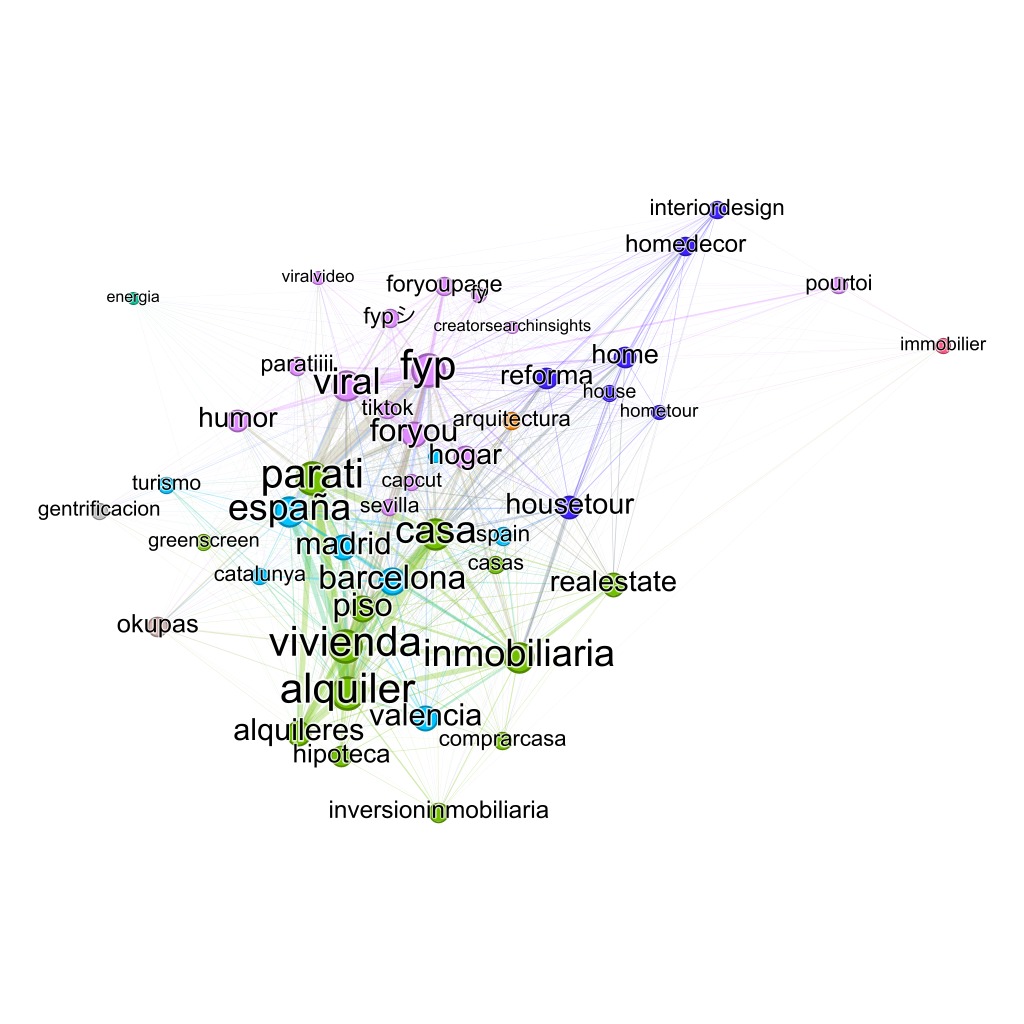
From the thematic clusters, we identified six categories to work with: real estate market, lifestyle, territory, politics, social issues and polarisation.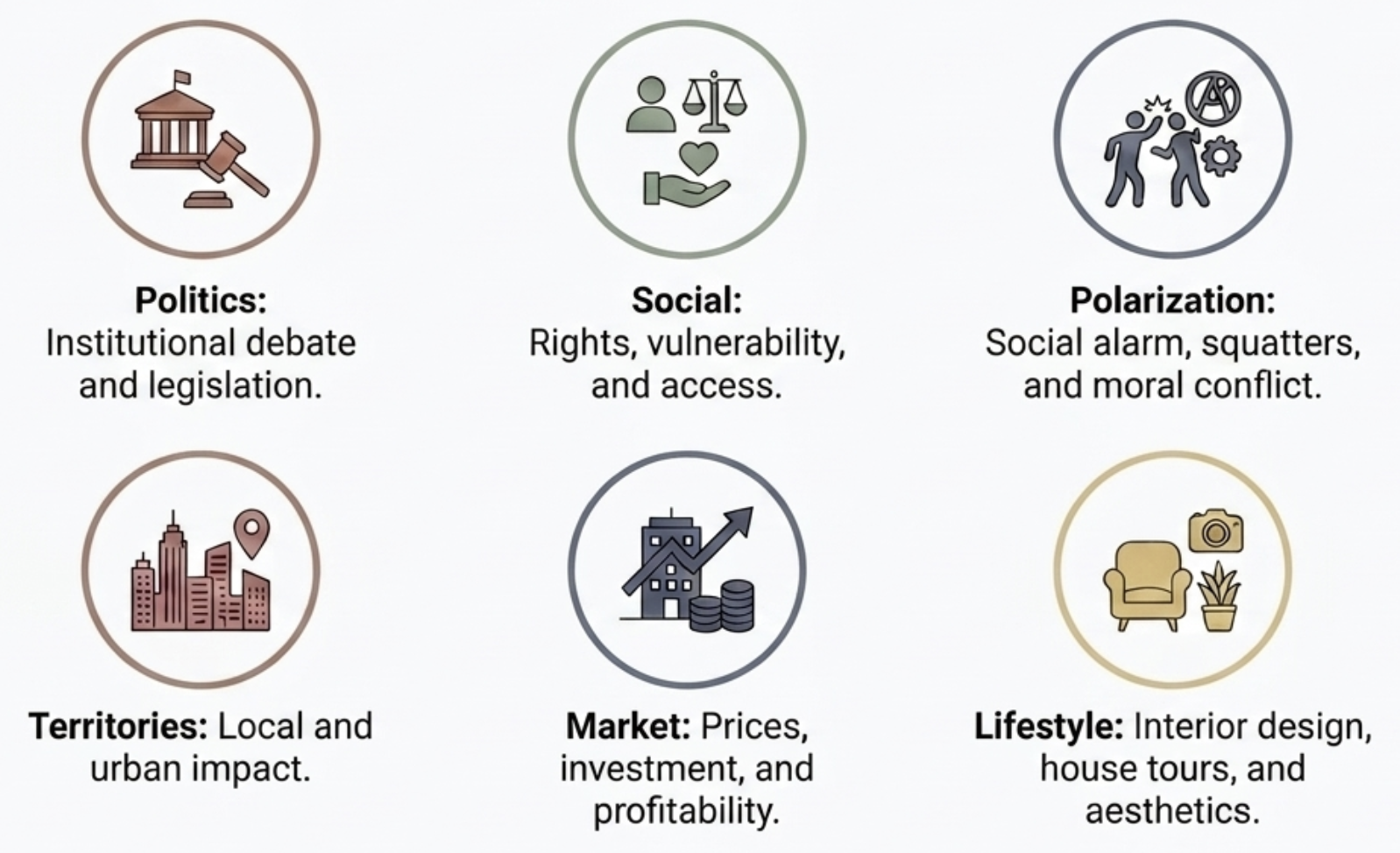
This categorisation helps us find our way around: adding this metadata to each post makes it easier to visualise and navigate the map through the interface. However, given the information provided to it, the OpenAI model’s margin of error makes it unreliable at the level of individual posts. It should not be treated as a definitive thematic categorisation.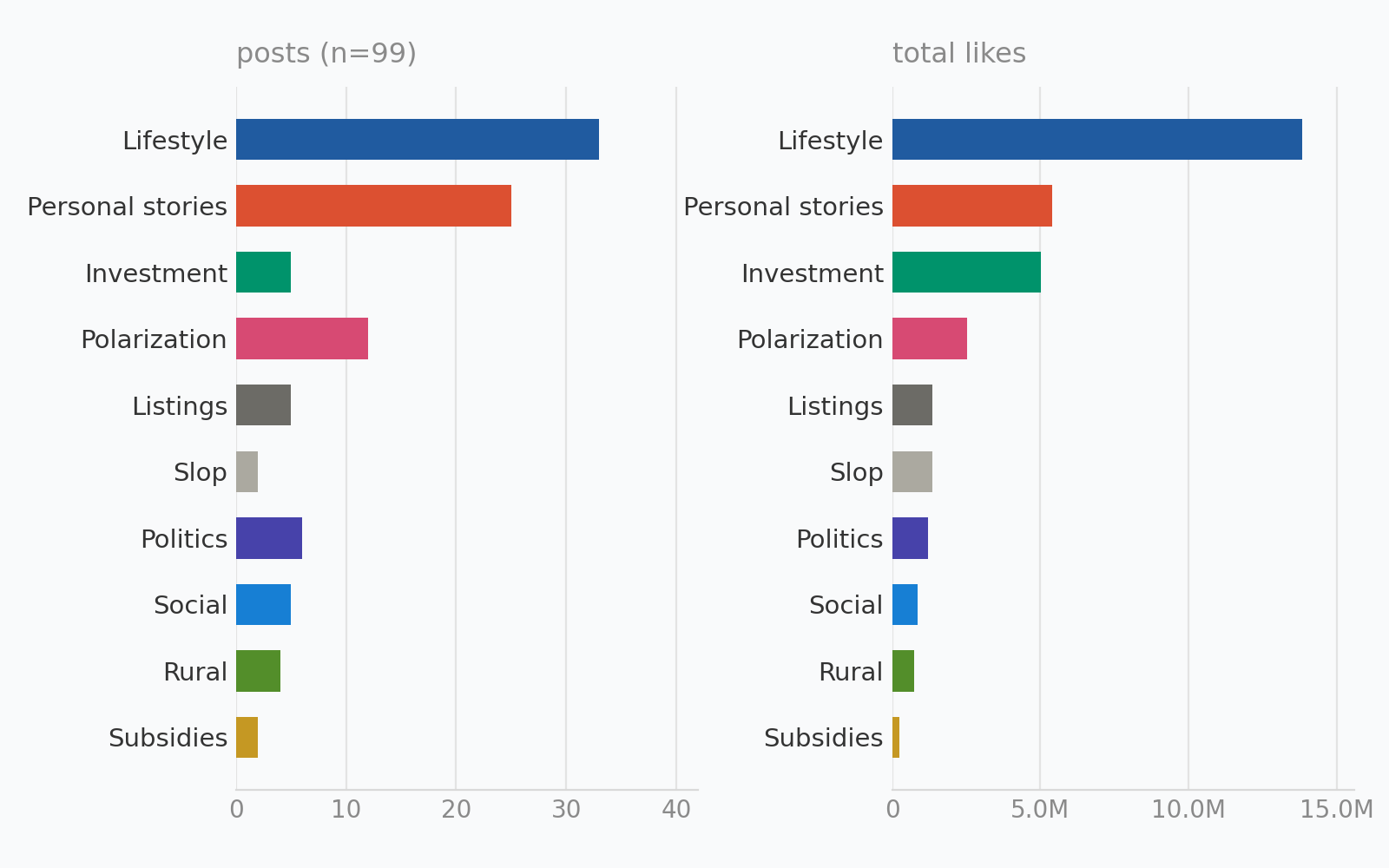
This qualitative analysis allows us to navigate the content and highlight some of the patterns we observed:
Housing as a setting for life, not as a problem
Label: Lifestyle: 13.8M likes across 33 videos
Lifestyle content dominates, including house tours, decoration, renovations and moving. Beyond a few posts where luxury is obvious and displayed almost voyeuristically (mansions, Ferraris…), many others normalise luxury by showing homes that are now beyond the reach of the vast majority. It is aspirational, aesthetic content geared towards product placement, such as furniture.
Everyday life around housing, told with humour and realism
Label: Lived experiences: 5.4M likes across 26 videos
There is a body of authentic content led by young people that reflects everyday experiences and life stages around housing: moving out, living alone, moving in with a partner, or having a friend come to stay. They joke about how expensive it is to become independent and what that first supermarket shop is like. The friction and reality young people face around the cost of living are openly acknowledged. Some of the patterns in this authentic content are also imitated by Lifestyle content, including more everyday posts that, from a young person’s perspective, document the search for a rental flat or offer practical guides on grocery shopping or moving out.
The market as a game to be won
Label: Investment: 5M likes across 5 videos
A small number of highly viral videos. Financial investment advice supposedly within “anyone’s” reach — promising success or ways to avoid taxes — is a classic that could hardly be missing. Housing is presented as a financial asset through “magic” formulas, encouraging speculation and opportunism. Everything is framed as a matter of having the right mindset.
The false problem of squatting (okupas) and non-paying tenants (inquiokupas)
Label: Polarisation: 2.5M likes across 12 videos
Beyond videos of Desokupa harassing people, a wide range of other messengers also push this narrative. Podcast conversations with Vito Quiles, music creators mixing urban aesthetics, “meme provocation” and patriotic codes, or estate agents commenting on the news. The latter spread unfounded fear through technical and seemingly neutral language.
Estate agents listing homes
Label: Listings: 1.4M likes across 5 videos
Very everyday content from estate agents showing homes for sale, often using the house tour format. Any kind of property can spark the audience’s curiosity, and small details in the videos often trigger comments rooted in humour: anecdotes such as the sweet husband accompanying the estate agent while trying to dodge the camera, a house that has been closed up for years, or another one that looks like something out of The Conjuring.
Slop content around housing
Label: Slop: 1.3M likes across 2 videos
3D or AI-generated animations designed to capture attention, showing how to lay out a room or the accelerated construction of a house. Attention is captured and sustained through constant visual stimuli (animations, quick cuts, on-screen text, striking images, effects, moving objects or hypnotic scenes), while a voiceover explains something complex. Context-free content designed to drive engagement.
The institutional agenda only goes viral occasionally
Label: Politics: 1.2M likes across 6 videos
Occasional news clips that went viral, statements by politicians, or sessions in Congress. The framing is institutional and journalistic: housing appears as a public-policy issue. Rufián speaks from Congress, or Sánchez from La Moncloa while giving a house tour.
Life in the countryside and village homes
Label: Rural: 4 posts, 752k likes
Buying a house in a village or living in the middle of the countryside. The content shows the condition of the home when moving in for the first time, the renovation process, or what everyday life in a rural house is like. Moving to the countryside is presented as a way to escape the city and deal with housing affordability.
Explaining public support schemes
Label: Public support: 228K likes across 2 videos
Using a green-screen format, creators share information about public support schemes and explain how to apply for them. The European Youth Card, for example, is presented as a trick that “people don’t know about”. If you work in this space, the creator to follow is Raúl: he is the king of this kind of content.
The image map for navigating the conversation
Analysing by hand the hundred most-viewed videos gives us a grounding point (there is a huge amount of information in a hundred TikToks), but we are aware that a hundred pieces of content from a sample of 8,756 barely scratch the surface of the scale of this conversation. That is why, rather than relying only on the big metrics of social media, we also wanted to look at the conversation through images.
Composite image made up of 8,756 TikTok video cover images, grouped by similarity: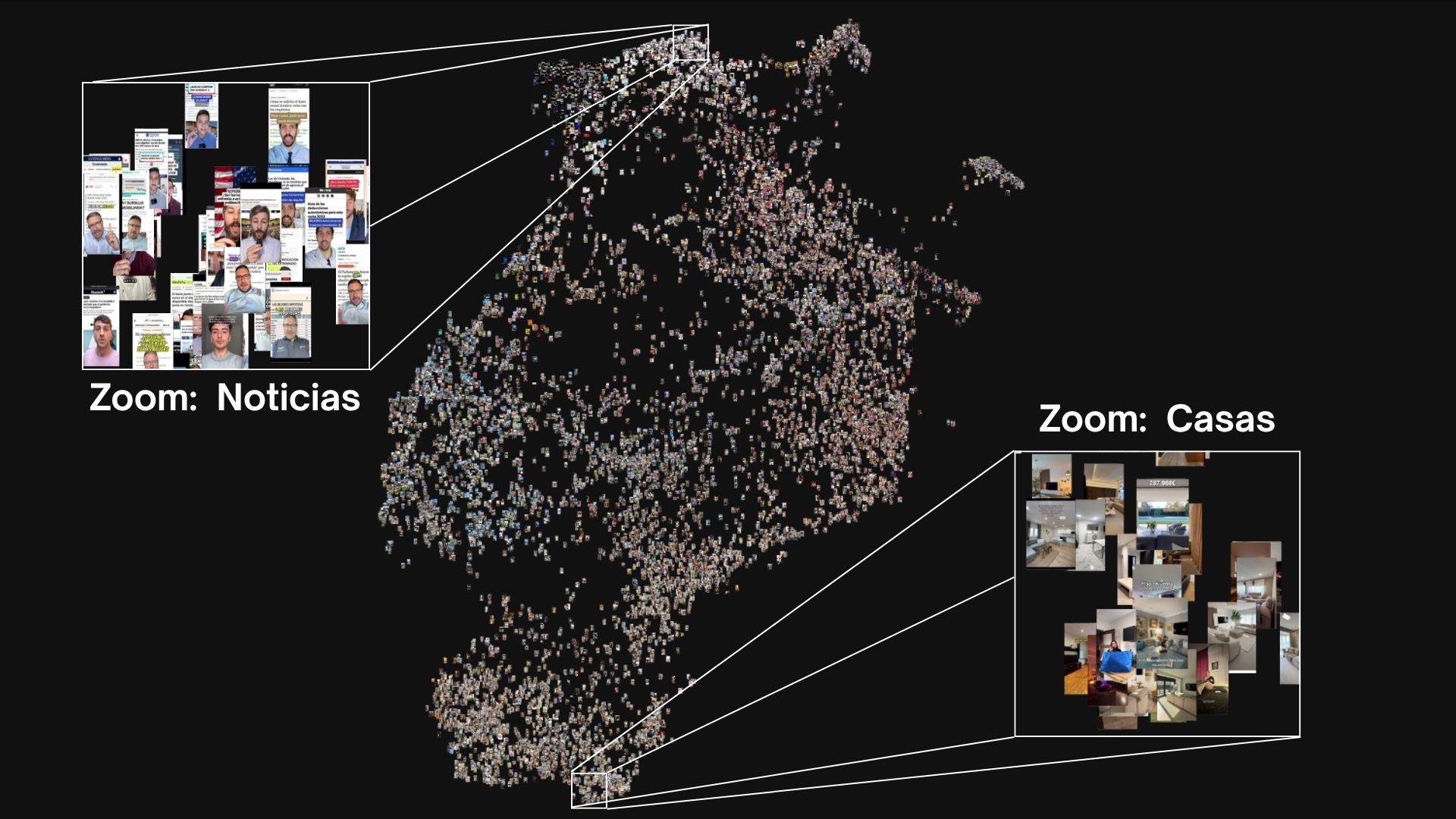
We downloaded the cover image of each TikTok and brought them all together into a single map using a tool called PixPlot. Behind the scenes, it works with an algorithm, but the basic idea is simple: first it “looks” at each image and reduces it to a kind of fingerprint (what colours it contains, what shapes appear, whether there is a face, a wall, a street); then it compares those fingerprints and places each image close to others whose fingerprints resemble its own. In this way, without anyone sorting them by hand, cover images that share a similar look (house tours, news clips with a person cut out over a background, building façades) end up clustering together in different areas of the map. The result is a landscape you can move through: you can view it from a distance to see the big clusters, or zoom in on a corner to look at the videos one by one.
We created this map so that it could speak to us, so that we could think with it as a group. And it does. The most obvious pattern is vertical: at the top, content commenting on the news with a green-screen format clusters together; at the bottom, the house tours. Following that logic, we explored the map in search of patterns, which we annotated directly onto the image itself. The percentages represent how much space each group takes up:
Composite image annotated: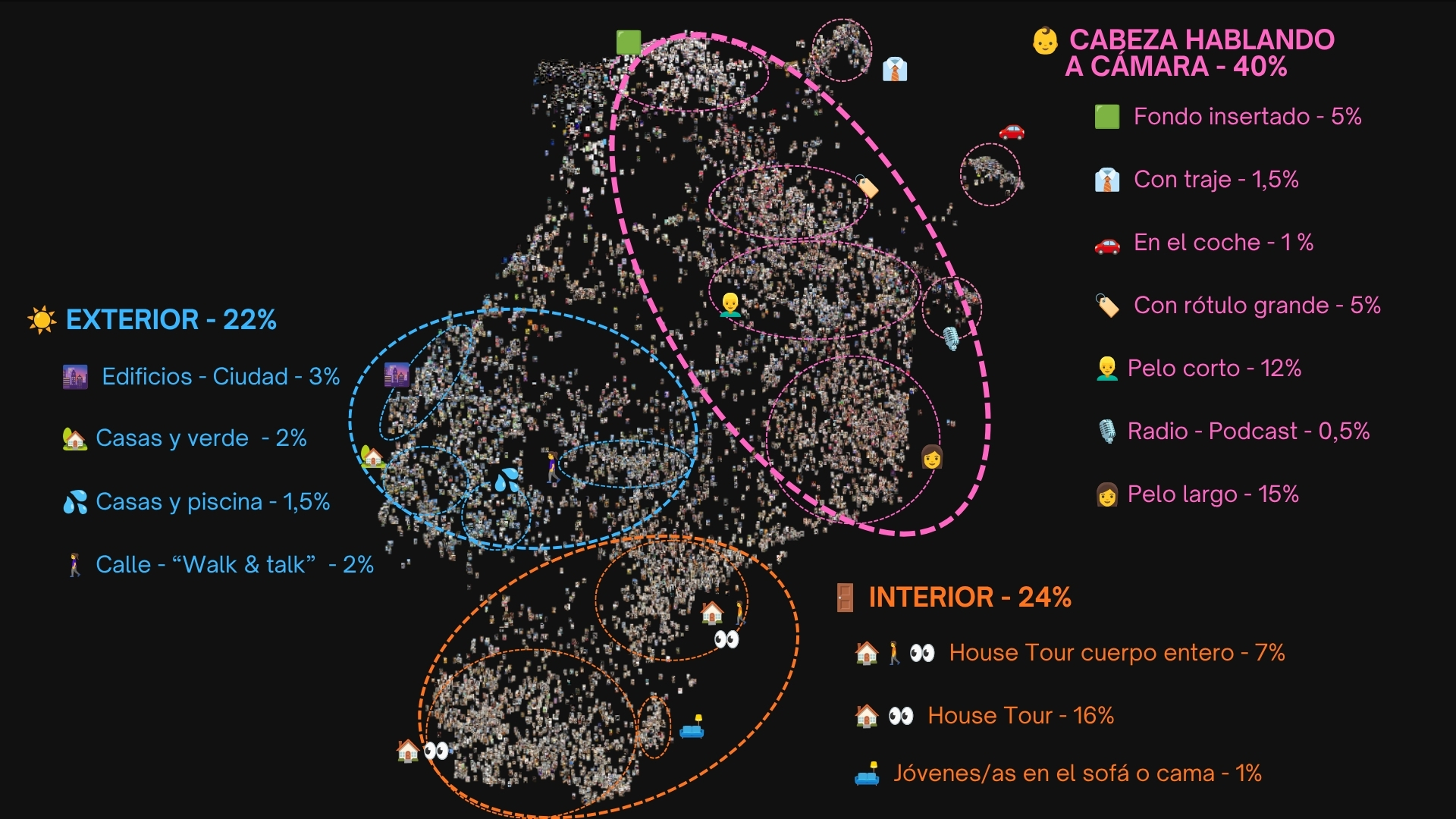
Based on the annotations in this image, we want to share the following conclusions:
To talk about housing on TikTok, all we need is a good messenger:
40% of the area in the composite image is occupied by people talking directly to camera, with little more than a strong personal message. In other words, a discursive format dominates. This invites us to collaborate with content creators we trust, give them creative freedom, and explore together how their experiences around housing intersect with our issues. Authentic, effective content that is easy to produce if you invest in relationships with creators.
There is little room for formal or political discourse. It is marginal:
Even though this is something we already know, it is worth remembering, because when we are defending the issues we care about, we often find it difficult to let go of more rational forms of communication and adapt to new codes. So here we want to draw a very clear line around when and how we can afford to be more serious, so that you can quickly rule out creative ideas that are unlikely to go anywhere. There are always exceptions and ways to make something work, but this is what we can recommend.
Commenting on the news in a useful way can work, as shown by the 5% of people talking to camera with a news item inserted in the background. You can also speak from a position of expertise, for example as an estate agent or another kind of expert, as some creators linked to the narrative around non-paying tenants (inquiokupas) do. We also came across the explainer format, with a light script that tells a story, as well as lifestyle creators offering advice on moving out.
From here, it is worth noticing how marginal content coming from the news is (1.5% of people wearing suits), as well as radio or podcast content (0.5%).
The house tour format is key, and you should use it:
At 23% of the content, it is the format that stands out the most. Within these posts, we find two main strands: a more highly produced lifestyle version, created by influencers, and a more everyday one, featuring a wider range of users as well as property listings. It is a very flexible format, since all you need are four walls to do a tour (there are room tours too), and it can be an excuse to talk about almost anything we are interested in: from features of the home, to encounters with tenants, to the history of the building. Pedro Sánchez has understood this.
It also connects with another key idea: we need the content around our cause to engage the senses and generate a sensory reaction, and looking at homes evokes a wide range of emotions. It does not matter how big they are, whether they are more comfortable homes or substandard housing. They make us feel something, and that creates an opening for conversation with the audience.
It is a discourse more dominated by women:
We found a fairly clear gender difference, which we will only try to explain in part, since there are many factors and possible interpretations. First, content featuring people with long hair talking to camera is more common (15%) than content featuring people with short hair (12%). The algorithm cannot infer gender, but this feature suggests that more of the discourse comes from female messengers. We interpret this as reflecting the larger number of women creators using a more reflective format and sharing personal experiences. By contrast, news commentary is more often done by men (5% with an inserted background), and the estate agents speaking to camera are also men, while women are more often the ones doing the work of showing ordinary homes.
Another factor is that lifestyle content, and therefore house tours, is dominated by women. We found fewer cases of men showing, for example, the process of sorting things out for a move or creating decoration content. Men tend to show the fact of having a new home more than the process around it.
In the street, we find more social and political content, among other things:
The street appears in the image mainly in two ways: a speaker in front of a building, either walking or standing still, or a street full of people at a demonstration, sometimes with someone being interviewed. This accounts for 2% of the content and, although some of it consists of property listings, what caught our attention is that there is more discourse here than in other formats. A building in the background creates an opportunity to talk about social housing, vulture funds or public policy: we see this in local councillors announcing public policies, in content denouncing the sale of social housing to a vulture fund, or in unions defending a housing block. Demonstrations work as a setting, with crowds of people and short street interviews making the content feel more lived and immediate. The message is grounded in the place.
Final reflections
If this map makes one thing clear, it is that the conversation about housing is already happening every day, and at scale, through a handful of native formats. The opportunity lies in entering those formats with the issues we care about. With that in mind, we close with a few recommendations.
For mainstream audiences, collaborating with lifestyle influencers offers a low-friction entry point: it can help shift consumption habits or reframe perceptions of climate solutions applied to housing. It is important to weigh cost against return and adapt the habit you are proposing to the audience’s purchasing power. And to be precise about the objective: for a very specific change, there are influencers with niche audiences that may be a perfect fit.
For younger audiences, the terrain is lived experience: everyday, lightly produced and highly authentic content through which people share experiences and life stages. One-off collaborations are harder here, so the way forward is to identify emerging creators, support them and build long-term relationships.
Underneath almost everything lies the same idea: housing as market value. It is the dominant narrative. It permeates everyday content and resonates easily with mainstream audiences; influencer lifestyle content and videos listing homes reinforce it as something natural. This clashes with the idea of housing as a right, and yet these “apolitical” creators are not necessarily acting in bad faith: some even acknowledge their privilege and share a social perspective (for example, influencer Marina Rivers’ response to criticism over buying a detached house). Others show a greater disconnect: newly wealthy creators who make ostentation and aspirational envy part of their content, or people comfortable in their privilege who do not seem to question it and live far removed from social reality. They are probably the ones who have been most affected by the so-called fall of influencers, because watching this kind of housing content leaves audiences with a lingering sense of frustration. For a strategy with a social perspective, work with more down-to-earth lifestyle creators — middle-class, younger creators — who do not shy away from the friction around housing (un)affordability. We cannot compete with brands when it comes to collaborations with major influencers.
We tend to design our communication strategies by looking at the two opposing sides. In doing so, we lose sight of the broad centre of the conversation, the dominant narrative, and with it the nuances that can build bridges.
At one extreme, radical content gains traction by attaching itself to this dominant market narrative. Property investment gurus push the idea of housing as a financial product to its limit. Legal advisers subtly fuel fear around squatting (okupas) and non-paying tenants (inquiokupas) through current-affairs content. Disinformation circulates portraying social housing as a resource disproportionately allocated to migrants: this feeds institutional distrust and erodes social trust. And Des0kupa shows people taking justice into their own hands, offering a forceful response to the fear they themselves have helped create.
At the other extreme, social movements and progressive content defend housing as a right. Their reach is marginal, highly discursive and, in most cases, disconnected from the codes of the platform.
That is why it makes sense to look less at the extremes and more at the mainstream, where most of the conversation is happening. That is where we can have an impact, put forward solutions without fear and build strategies that create bridges.
We should not dismiss people who are simply doing their jobs. Estate agents create content every day, are good communicators and often feel very approachable; we can provide them with useful information, propose an award or competition based on social criteria, or explore some form of collaboration. It is worth following Grupo Country Homes and Alquilo Fácil Albacete to better understand these kinds of profiles.
What becomes clear as we move through this map is that there is no visible climate conversation. Ultimately, everything points in the same direction: the conversation about housing on TikTok is already happening every day, and at scale, and we are almost never the ones leading it. The opportunity lies in entering the conversation that is already working — the house tour, lived experience, the home that sparks emotion — and bringing the issues we care about into those spaces. That is why, in the next analysis, we ask what climate solutions can contribute to this conversation, and set out to find where climate is already beginning to surface within it.
Acknowledgements
This observatory is a collective effort. Alongside the Komons team, it brings together a group of climate communication experts and content creators: Marta Donlo (WWF Spain), Olga Raurell (UPF), Alejandra Gallardo (Platoniq), Belén Hinojar (@Climabar), Diego Ferraz (@ecodiuku), Lorena Macías (@hazmeunafotoasi), Clara Tomé (@iamcleer), and Sara Riviero (@wokeup.news). Data analysis and technical development were led by Alejandro González and Serge Scevenels. Marta G. Franco (LaIntersección) contributed a technopolitical perspective and supported the coordination, led by Alberto Abellán (Komons). All of this was made possible thanks to the European Climate Foundation and its commitment to nurturing the ecosystem of climate communicators.
And an invitation. If you work on housing or climate communication and something you have read here resonates with you, let’s talk. We can discuss the analysis and walk you through the map with your goals in mind. Write to us at alberto@komons.org.